
Quick Summary:
To read natural ingredient labels, ignore the front claims, scan the first five ingredients, and avoid hidden toxins like fragrance, parabens, and sulfates. Focus on products with plant-based oils, butters, and extracts listed at the top for truly clean beauty.
Ever picked up a shampoo or lotion bottle that practically screamed “100% Natural!” on the front, only to flip it over and feel totally lost by the microscopic ingredient list on the back?
You are definitely not alone.
As more of us wake up to the realities of what we put on our bodies, the demand for cleaner, safer, and truly natural products has skyrocketed. We want products that nourish our skin, support healthy hair growth, and protect our long-term health. But let’s be brutally honest: cosmetic labels are often confusing on purpose.
If you’ve ever felt like you need a chemistry degree just to buy a daily moisturizer or a hormone-safe shampoo, this guide is for you. Below, I will show you exactly how to read natural ingredient labels, how to spot deceptive marketing, and how to protect your body from hidden toxins.
The Big “Natural” Lie: What Product Labels Actually Mean
Here is the uncomfortable truth about the beauty and personal care industry: The word “natural” is often just a marketing tactic, not a legally binding promise.
Unlike the food industry, the cosmetics and personal care industry is shockingly under-regulated in many parts of the world. Because there is no strict, legal definition for the word “natural” in skincare or haircare, brands can use it freely.
This leads to a widespread practice known as “Greenwashing.” Greenwashing is when a company uses deceptive marketing to make its products seem more environmentally friendly or healthier than they actually are. They use green packaging, pictures of lush leaves, earth-toned bottles, and buzzwords like botanical, pure, or clean to project a healthy image.
But a pretty bottle doesn’t equal a safe product. A shampoo could contain 95% synthetic chemicals and harsh detergents, but as long as they drop in 1% aloe vera extract, they can legally slap “Made with Natural Aloe” on the front label.
👉 The front label sells you a carefully crafted story. 👉 The back label tells you the undisputed truth.
The Anatomy of an Ingredient Label (Where to Look First)
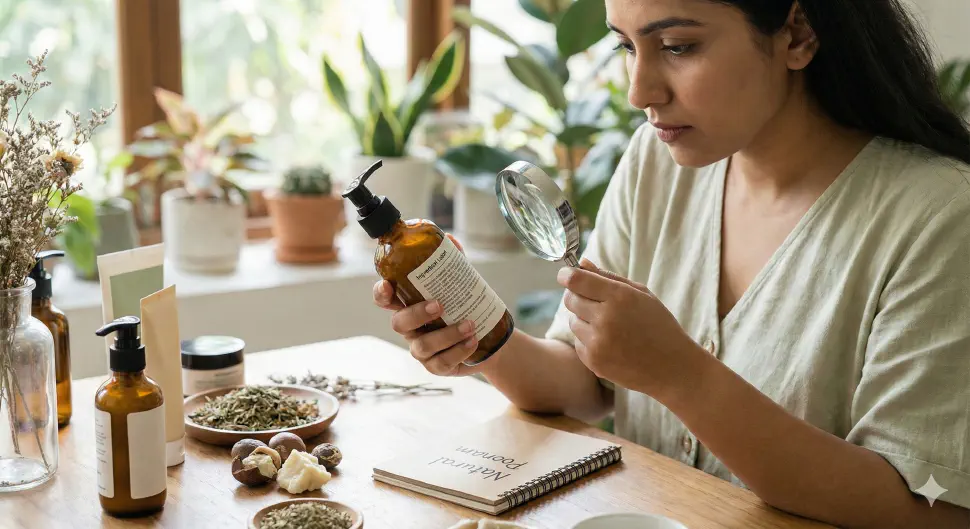
Skip the glossy hype on the front of the package and go straight to the ingredient list—usually found on the back or the bottom of the bottle. This is where the real information lives, but you have to know how to read it.
Ingredients are listed using a standardized system called INCI (International Nomenclature of Cosmetic Ingredients). While it looks like a jumble of Latin and scientific terms, there are two golden rules you need to know:
1. The “First 5” Rule
By law, ingredients must be listed in descending order of concentration. That means the first ingredient on the list is what the product contains the most of (usually water or a base oil). The first 3 to 5 ingredients typically make up 80% to 90% of the entire product. If you are looking for a truly natural product, those top five ingredients need to be recognizable, plant-based powerhouses. If the first few ingredients are harsh detergents or synthetic silicones, the product isn’t truly natural, no matter what the front label says.
2. The 1% Rule Loophole
Here is a sneaky industry secret: Once ingredients drop below a 1% concentration level in the formula, the brand can list them in any order they want at the bottom of the list. Brands often take advantage of this by pushing their “star” natural ingredients (like Argan Oil or Rosehip Extract) slightly higher up in the bottom section to make them look more prominent, even if there is barely a drop in the bottle.
Green Lights: The Best Natural Ingredients for Your Skin & Scalp
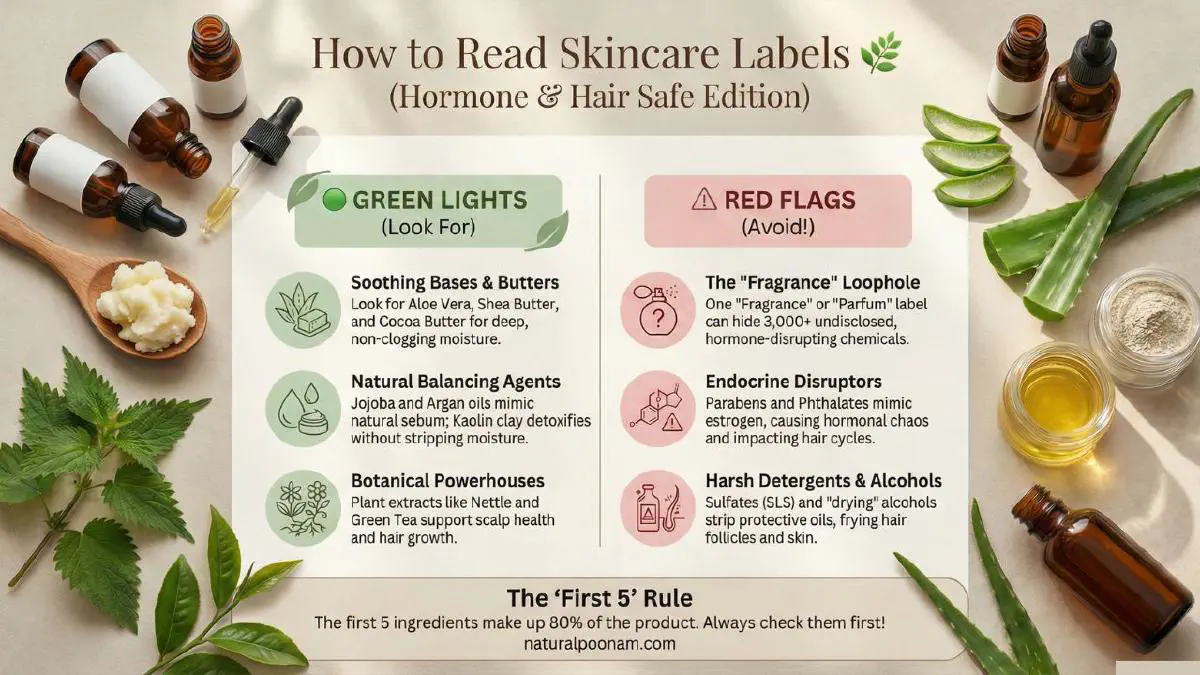
When you’re scanning labels, look for these recognizable, nourishing ingredients near the top of the list. These are especially vital if you are trying to heal your scalp, balance your body, or encourage healthy hair growth:
- Aloe Vera (Aloe Barbadensis): Incredibly soothing for inflammation, dry scalps, and sensitive skin. Often used as a hydrating base instead of plain water.
- Plant Butters: Look for Shea Butter (Butyrospermum Parkii), Cocoa Butter (Theobroma Cacao), or Mango Butter. These provide deep, natural moisture without clogging pores.
- Carrier Oils: Jojoba Oil, Argan Oil, Coconut Oil, and Sweet Almond Oil. Jojoba is particularly amazing because it mimics the scalp’s natural sebum, making it perfect for balancing oily or dry hair.
- Plant Extracts: Green tea extract, chamomile, and nettle leaf. Nettle is fantastic for blocking DHT, a hormone often responsible for thinning hair in women.
- Natural Clays: Bentonite, Kaolin, or Rhassoul clay. These naturally detoxify the scalp and skin without stripping away essential moisture.
- Essential Oils (Further down the list): Rosemary, Peppermint, Lavender, and Tea Tree. Rosemary oil, in particular, has been shown to support healthy circulation to the hair follicles. (Note: Because essential oils are potent, they should be near the middle or bottom of the list).
These ingredients are the backbone of high-quality, truly natural routines because they work with your body’s biology, not against it.
Sneaky Buzzwords That Mean Absolutely Nothing
When shopping, be on high alert for these marketing buzzwords. They feel safe, but they don’t actually guarantee a clean product:
- “Dermatologist Tested” – This literally just means a dermatologist looked at it or tested it on someone. It does not mean the dermatologist approved it, liked it, or deemed it safe from toxic chemicals.
- “Herbal Blend” or “Proprietary Blend” – This is vague and unregulated. It’s a way for companies to group ingredients together without telling you exactly how much of the good stuff is actually in there.
- “Plant-Based” – Just because an ingredient originated from a plant doesn’t mean it wasn’t heavily processed with toxic chemicals in a lab before it made it into your shampoo.
- “Unscented” vs. “Fragrance-Free” – This is a massive trap. “Unscented” does not mean the product has no chemicals. It often means the company used masking chemicals to hide the smell of the other harsh ingredients. Always look for “Fragrance-Free” instead.
Red-Flag Ingredients You Must Avoid (Especially for Hormone & Hair Health)
You don’t need to memorize a chemistry textbook to shop safely. You just need to scan the label for a few major offenders.
This is incredibly important if you are dealing with hormonal imbalances, PCOS, thyroid issues, or postpartum hair loss. Many conventional beauty products are loaded with “endocrine disruptors”—chemicals that mimic or block your body’s natural hormones, leading to worse hormonal chaos and increased hair thinning.
Avoid these red flags at all costs:
1. Fragrance / Parfum (The Ultimate Loophole)
If you only take one thing away from this guide, let it be this: Avoid the word “Fragrance” or “Parfum.” Under current trade secret laws, a company does not have to disclose what makes up their “fragrance.” That one single word on a label can legally hide a cocktail of up to 3,000 different undisclosed synthetic chemicals, many of which are known allergens and hormone disruptors. If a brand is truly natural, they will scent their products with specific essential oils and list them by name.
2. Parabens (Methylparaben, Propylparaben, Butylparaben)
Parabens are cheap synthetic preservatives used to give products a longer shelf life. The problem? They are notorious endocrine disruptors. They mimic estrogen in the body, which can severely disrupt your delicate hormonal balance. When your hormones are out of whack, your hair growth cycle is one of the first things to suffer.
3. Phthalates (Often hidden in “Fragrance”)
Phthalates are chemicals used to make fragrances stick to your skin and hair longer, and to make plastics more flexible. Like parabens, they are major endocrine disruptors linked to reproductive issues and hormonal imbalances.
4. Sulfates (SLS and SLES)
Sodium Lauryl Sulfate (SLS) and Sodium Laureth Sulfate (SLES) are harsh, synthetic detergents. They are what make your shampoo and face wash foam up into a thick lather. However, they are industrial-strength degreasers. They completely strip your skin and scalp of their natural, protective oils. This leads to severe scalp irritation, dry and brittle hair, and can exacerbate hair fall.
5. Formaldehyde Releasers (DMDM Hydantoin, Urea)
You probably know formaldehyde as an embalming fluid, but it’s shockingly common in hair care. Because pure formaldehyde is widely recognized as a carcinogen, brands use “formaldehyde releasers” instead. These chemicals slowly release formaldehyde over time to preserve the product. Look out for DMDM hydantoin, Diazolidinyl urea, and Quaternium-15.
6. Harsh Alcohols
While some fatty alcohols are good for the skin (like Cetearyl alcohol), you want to strictly avoid harsh drying alcohols near the top of an ingredient list. Look out for SD Alcohol, Denatured Alcohol, or Isopropyl Alcohol. These will instantly dehydrate your skin and fry your hair follicles.
A Simple 3-Step Method to Decode Any Label in 30 Seconds
I know this feels like a lot of information, but you don’t have to be perfect from day one. Use this simple, 30-second checklist every time you shop to instantly upgrade your routine:
Step 1: Ignore the front label completely. Words like “natural,” “clean,” and “earth-friendly” are there to sell, not to educate. Turn the bottle around immediately.
Step 2: Scan the first 5 ingredients. Are they mostly natural oils, plant extracts, water, or butters? Or are they a long list of chemical names, sulfates, and silicones you don’t recognize? Remember, those first five items make up the vast majority of what you are paying for.
Step 3: Scan for the “Big Three” hidden red flags. Specifically, run your eyes over the list and actively look for the word “fragrance,” parabens, and sulfates. If you spot them, put the bottle back on the shelf.
By simply following this 3-step method, you will automatically filter out 90% of the toxic junk on store shelves.
Frequently Asked Questions About Natural Labels
Is “organic” better than “natural”? Yes, almost always. The term “Organic” is strictly regulated by government bodies in many countries (like the USDA in the United States). If a product carries an official organic seal, it means the ingredients were grown and processed without synthetic pesticides, genetically modified organisms (GMOs), or artificial fertilizers. “Natural,” on the other hand, is a free-for-all term.
Are long, hard-to-pronounce ingredient names always bad? Not always! This is a common misconception. As mentioned earlier, the INCI naming system requires companies to use standardized scientific names. Some incredibly safe, natural ingredients just have complicated Latin names. For example:
- Butyrospermum Parkii = Shea Butter
- Tocopherol = Vitamin E
- Sodium Chloride = Sea Salt The real problem isn’t the length of the name; it’s when the list is packed with harsh synthetic detergents, PEGs, and artificial preservatives.
Do essential oils mean a product is 100% natural? Not automatically. This is a classic greenwashing trick. A brand will create a completely synthetic, chemical-laden shampoo, drop in 0.5% lavender essential oil, and market it as a “Soothing Lavender Natural Shampoo.” A product can contain pure essential oils and still be packed with toxic fillers. Always read the whole label.
Do natural products expire faster? Sometimes, yes. Because truly natural products don’t use harsh synthetic preservatives like parabens, their shelf life can be shorter (usually 6 to 12 months after opening). Look for a tiny icon on the back of the jar that looks like an open lid with a number inside (e.g., “6M” or “12M”). This tells you how many months the product is good for after you open it.
Is fragrance always toxic?
Not always, but “fragrance” on labels is legally allowed to hide hormone-disrupting chemicals. Look for products scented with specific essential oils instead.
What are endocrine disruptors in beauty products?
They are chemicals that interfere with your hormones, often linked to hair thinning, scalp inflammation, PCOS flare-ups, and cycle irregularities.
Can toxic shampoo cause hair loss?
Yes. Sulfates, parabens, and formaldehyde releasers can inflame hair follicles, disrupt hormones, and weaken the scalp barrier over time.
How long does it take to see results after switching to clean beauty?
Most women notice scalp relief within 2–4 weeks and reduced hair shedding within 6–12 weeks.
Final Thoughts: Take Your Power Back
When I first started switching to natural products, I trusted the packaging. Everything looked so incredibly healthy on the surface! But over time, as I learned to dig deeper into my health, I realized the ingredient list is the only thing that tells the real story.
Learning how to read natural ingredient labels puts the power back into your hands. You don’t need to be a chemist—you just need to know where to look and what to avoid.
Your skin, your hormones, and your hair deserve so much better than clever marketing and hidden toxins. Start small. The next time you run out of your daily shampoo or body lotion, use this guide to swap it out for something truly nourishing.