
If your “acne” isn’t clearing up despite months of the usual treatment — or is actually getting worse — it might not be acne at all. A surprising number of persistent, treatment-resistant breakouts turn out to be Malassezia folliculitis, commonly called fungal acne: a yeast overgrowth in hair follicles that looks like acne but responds to a completely different treatment. It’s also significantly more common during monsoon and humid weather, which is exactly when this confusion tends to peak.
👉 For hormonal and jawline acne specifically, see Secrets of Chinese Face Mapping: Holistic Approaches to Acne Treatment — this guide covers the fungal vs. bacterial distinction that article doesn’t.
What Causes Each
- Bacterial acne develops when Cutibacterium acnes bacteria, excess sebum, and clogged pores combine, often driven by hormones, stress, or diet.
- Fungal acne (Malassezia folliculitis) happens when Malassezia yeast — which normally lives harmlessly on everyone’s skin — overgrows inside hair follicles, triggering inflamed, itchy bumps. A clinical review describes this condition as frequently “masquerading” as ordinary acne, which is exactly why it gets misdiagnosed and mistreated so often (source: Malassezia (Pityrosporum) Folliculitis Masquerading As Recalcitrant Acne, PMC).
How to Tell Them Apart
| Feature | Bacterial Acne | Fungal Acne |
|---|---|---|
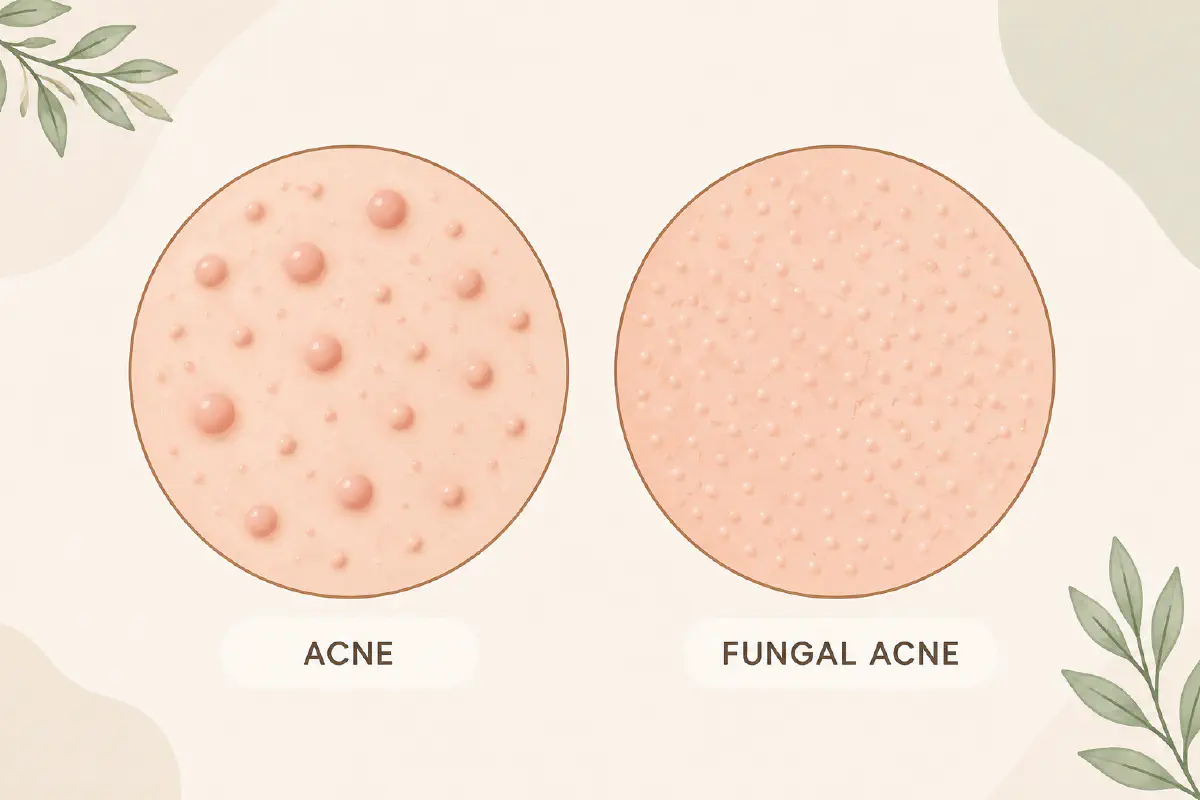
| Bump size | Varies — blackheads, whiteheads, cysts | Uniform, small, similar-sized bumps |
| Itch | Usually not itchy | Often itchy |
| Location | Face, especially T-zone and jawline | Chest, back, shoulders, hairline — as well as face |
| Response to antibiotics | Usually improves | No improvement, sometimes worsens |
| Clusters | Scattered, varied | Appears in tight clusters of similar bumps |
What Malassezia Actually Is
Malassezia isn’t an invading pathogen — it’s a yeast that lives on everyone’s skin as a normal part of the skin microbiome, similar in concept to how gut bacteria are normally present and only cause problems when the balance shifts (see our gut-skin axis guide for the same “normal resident organism, problem only on overgrowth” pattern in the gut). Malassezia specifically feeds on lipids (oils), which is why it flares in oilier, sweatier, more occlusive conditions — and why it’s often more common on the chest, back, and shoulders (areas with more sebaceous activity and less airflow) than the classic T-zone/jawline pattern of bacterial acne.
A Common Misdiagnosis Pattern
A frustrating cycle shows up often: breakouts don’t improve on standard acne treatment, so the response is to escalate — stronger benzoyl peroxide, a prescription antibiotic, a harsher cleanser. If the underlying issue is fungal, none of this helps, and some of it actively makes things worse, since disrupting the skin’s bacterial balance further can give Malassezia even more room to overgrow. The escalation itself becomes a diagnostic clue: treatment that keeps failing despite trying harder is a more useful signal to reconsider the diagnosis than to reconsider the product strength.
The Diagnostic Clue Most People Miss
The single most useful clue: if “acne” doesn’t improve, or actively gets worse, after weeks of standard treatment (benzoyl peroxide, topical or oral antibiotics), that’s a strong signal it may be fungal rather than bacterial. Antibiotics don’t affect yeast at all, and can even make fungal acne worse by killing off competing bacteria that normally help keep Malassezia in check. This is precisely the pattern described in the clinical literature as “recalcitrant acne” that turns out to be a fungal folliculitis instead.
Why Monsoon and Humid Weather Make This Worse
Malassezia yeast thrives specifically in warm, moist environments — which is exactly what monsoon season and humid climates provide. Contributing factors during humid weather include:
- Sweat that isn’t rinsed off promptly, creating a warm, damp environment in hair follicles
- Tight, non-breathable clothing trapping moisture against skin, especially on the chest and back
- Heavy, occlusive skincare or body products that trap humidity against the follicle rather than letting it evaporate
- Increased oil production in hot weather, which Malassezia (a lipid-dependent yeast) can feed on
Treatment: Why the Same Products Don’t Work for Both
| Approach | Bacterial Acne | Fungal Acne |
|---|---|---|
| First-line treatment | Benzoyl peroxide, salicylic acid, topical/oral antibiotics | Topical antifungals (ketoconazole, clotrimazole), antifungal shampoo used as a body wash |
| What to avoid | — | Benzoyl peroxide and antibiotics — can worsen fungal overgrowth |
| Common OTC option | Benzoyl peroxide wash | Selenium sulfide or ketoconazole shampoo, left on skin for a few minutes before rinsing |
👉 Tea tree oil’s antifungal properties, already covered in our dandruff remedies guide for scalp fungal issues, can be a reasonable natural adjunct for body fungal acne too — diluted, and patch-tested first.
Monsoon-Specific Prevention
- Shower promptly after sweating, rather than staying in damp clothes
- Choose breathable, moisture-wicking fabrics over tight synthetic clothing during humid months
- Switch to lighter, non-comedogenic, non-occlusive products during monsoon season specifically — see our combination skin routine for zone-based lightweight product strategies that apply here too
- Avoid sharing towels and bedding without regular washing, since Malassezia can spread through prolonged fabric contact
Can You Have Both at Once?
Yes — bacterial acne and fungal folliculitis can coexist, which is part of what makes self-diagnosis genuinely difficult. If treating for one type doesn’t help and you’re not confident which you’re dealing with, a dermatologist can often tell by appearance alone, or with a quick skin scraping if needed.
When to See a Dermatologist
- Breakouts that haven’t improved after 4-6 weeks of appropriate treatment for what you assumed it was
- Itchy, uniform bumps that got worse after starting antibiotics
- Widespread involvement on the chest/back/shoulders, which is less typical of standard facial acne
- Recurring flares that reliably track with hot, humid weather
Frequently Asked Questions
Can fungal acne go away on its own?
It’s unlikely without addressing the underlying yeast overgrowth and the conditions (heat, moisture, occlusion) that feed it — antifungal treatment plus the prevention steps above are the more reliable path.
Is fungal acne contagious?
Malassezia is normally present on everyone’s skin already, so it’s not “caught” from someone else the way an infection typically is — but sharing unwashed towels or tight clothing in humid conditions can contribute to flare-ups in susceptible skin.
Why did my acne get worse when I started an antibiotic?
This is one of the more reliable signs that what you’re dealing with is fungal, not bacterial — antibiotics don’t treat yeast, and can disrupt the bacterial balance that normally keeps Malassezia in check.
Does diet affect fungal acne the way it affects bacterial acne?
Not through the same well-documented pathways — fungal acne is driven more directly by heat, humidity, occlusion, and yeast overgrowth than by the insulin/IGF-1 pathways discussed in our diet-skin connection guide, which is more relevant to bacterial acne specifically.
Can I use the same cleanser for fungal acne as I do for regular acne?
Not ideally — a benzoyl peroxide or salicylic acid cleanser formulated for bacterial acne won’t address yeast overgrowth, and in some cases the disruption to skin’s bacterial balance can make fungal acne worse. An antifungal wash (ketoconazole or selenium sulfide) is the more appropriate choice while you’re addressing a suspected fungal flare.
Is fungal acne more common in oily climates or dry ones?
Humid, warm climates are the bigger driver, since Malassezia needs both warmth and moisture to overgrow — dry heat alone doesn’t create the same environment, which is part of why monsoon and humid-season flares are so consistent. See our full seasonal skin and hair guide for how other seasons affect skin differently.
Final Thoughts
Not every stubborn breakout is acne in the way most treatments assume. If your routine keeps failing — or your skin gets worse on standard acne treatment — fungal folliculitis is worth genuinely considering, especially during monsoon or humid weather when Malassezia has exactly the warm, damp environment it needs to overgrow.