
Not every mark left behind by a breakout is actually a scar — and confusing the two leads to a lot of wasted money on scar treatments for something that would have faded on its own, or the opposite mistake: waiting patiently for a true scar to fade when it structurally can’t without intervention. The distinction matters more than almost anything else in this topic.
👉 For active breakouts themselves, see Secrets of Chinese Face Mapping: Holistic Approaches to Acne Treatment. This guide covers what’s left behind afterward.

Marks vs. Scars: The Distinction That Matters Most
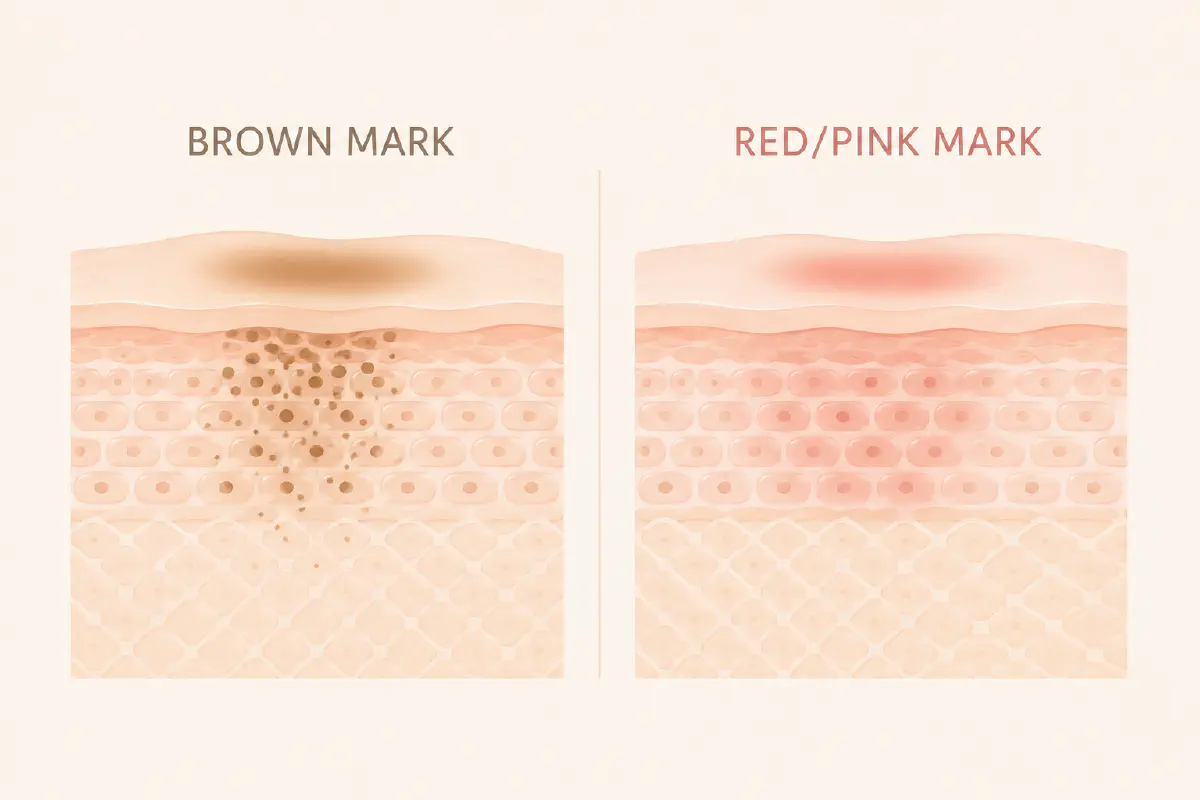
- Post-inflammatory hyperpigmentation (PIH) and post-inflammatory erythema (PIE) are flat discoloration — brown or red/pink respectively — caused by melanin or blood vessel changes near the skin’s surface. These are marks, not structural damage, and they genuinely fade on their own over time.
- True atrophic scarring (icepick, boxcar, rolling) involves actual loss of collagen and tissue structure. These are scars, and they do not fade on their own — meaningful improvement requires a procedure.
PIH: Brown, Flat, Melanin-Driven
Post-inflammatory hyperpigmentation is a flat brown mark left after inflammation triggers excess melanin production in that spot. It typically fades naturally over 6-12 months, faster with consistent care and dramatically slower (or not at all) with continued sun exposure.
What helps: daily sunscreen is the single highest-leverage step, since UV exposure directly worsens and prolongs PIH. Vitamin C, niacinamide, and retinoids all have real evidence for speeding up fading.
👉 See Sunscreen Myths Debunked and What Sun Damage Actually Does to Skin — the same UV-driven pigmentation mechanism covered there applies directly here.
PIE: Red or Pink, Flat, Vascular
Post-inflammatory erythema is a different mechanism entirely — flat red or pink discoloration from dilated blood vessels in the dermis left behind after inflammation, more noticeable on lighter skin tones. This is the same underlying vascular mechanism behind the vascular type of dark circles.
👉 See Dark Circles: What Actually Causes Them and What Helps — vitamin K and caffeine’s vasoconstrictor logic there applies to PIE too, though resistant PIE often responds better to vascular laser treatment than topicals.
True Atrophic Scarring: Icepick, Boxcar, and Rolling
This is where the honest answer changes. Dermatology classifies atrophic (indented) acne scars into three types using Jacob’s classification:
| Type | Appearance |
|---|---|
| Icepick | Narrow, deep, sharply defined — like a small puncture |
| Boxcar | Wider, box-like edges, shallower than icepick |
| Rolling | Broad, shallow depressions with sloping edges, creating a wavy texture |
Unlike PIH and PIE, these represent actual lost collagen and tissue structure. No topical product meaningfully fills in this kind of structural loss. Microneedling has the best primary evidence among less invasive options, working by creating controlled micro-injuries that stimulate genuine collagen remodeling. Fractional CO2 laser is considered the gold standard for more significant remodeling.
The Opposite Problem: Hypertrophic and Keloid Scars
Less common with acne specifically, but worth distinguishing: hypertrophic and keloid scars are raised, caused by an overproduction of collagen during healing rather than a loss of it — the structural opposite of icepick, boxcar, and rolling scars. These respond to a completely different treatment approach: corticosteroid injections, silicone sheets/gels, or pressure therapy, rather than the collagen-stimulating treatments (microneedling, laser resurfacing) used for atrophic scars. Applying an atrophic-scar treatment to a raised scar, or vice versa, generally won’t help and can occasionally make things worse.
An Important Safety Point for Deeper Skin Tones
This is worth knowing before pursuing laser treatment specifically: ablative CO2 laser, despite being the gold-standard scar treatment, has been shown to cause post-inflammatory hyperpigmentation in up to 92% of patients with Fitzpatrick skin type IV and above (medium to deeper skin tones). In other words, the “best” treatment for one problem can directly cause the other problem covered in this article, disproportionately for darker skin tones. Non-ablative fractional lasers and radiofrequency microneedling carry meaningfully lower PIH risk, though with somewhat less dramatic remodeling — a genuine tradeoff worth discussing directly with a dermatologist who has real experience treating your specific skin tone, rather than assuming the “gold standard” option is automatically the right choice for everyone.
What Actually Helps, By Type
| Type | Fades on Its Own? | What Helps |
|---|---|---|
| PIH (brown) | Yes, 6-12 months typically | Sunscreen, vitamin C, niacinamide, retinoids |
| PIE (red/pink) | Yes, though often slower than PIH | Time, gentle care; vascular laser for resistant cases |
| Atrophic scars (icepick/boxcar/rolling) | No | Microneedling, fractional laser, filler (for rolling scars specifically), with real skin-tone-specific risk considerations |
Frequently Asked Questions
How do I know if I have a mark or a true scar?
Gently stretch the skin around the area. Flat discoloration that doesn’t change in texture is likely PIH or PIE (a mark); a visible indentation that remains regardless of stretching is a true atrophic scar.
Can picking or popping pimples cause permanent scarring?
Yes — picking increases inflammation and tissue damage, raising the risk of true structural scarring rather than just temporary PIH or PIE, which is one of the most consistent, well-supported reasons dermatologists advise against it.
Is it worth waiting to see if a mark fades before trying treatments?
Generally yes for PIH and PIE — giving it a few months while using sunscreen and gentle actives is reasonable before assuming it needs more aggressive intervention, since both types commonly resolve substantially on their own.
Are at-home microneedling devices as effective as in-office treatment?
At-home rollers use much shorter needle lengths than professional devices for safety reasons, and the evidence for meaningful scar remodeling is strongest for the deeper, professional-grade treatments — at-home devices are a much more modest intervention by comparison.
Can I have more than one type of scarring or marking at once?
Yes — it’s common to have PIH, PIE, and true atrophic scarring simultaneously from different breakouts healing differently, which is part of why a dermatologist’s evaluation can be more useful than guessing at a single at-home approach for everything.
Does diet or supplements help fade acne scars?
Not through a well-established direct mechanism — collagen-supportive nutrition (see our collagen-boosting soups guide) supports overall skin collagen synthesis generally, but there’s no strong evidence it specifically reverses established atrophic scarring the way a procedure can.
Final Thoughts
The most useful thing you can do after a breakout clears is correctly identify what’s left behind: flat brown or red marks are patience-and-sunscreen problems that resolve largely on their own, while true indented scarring is a structural problem that needs a procedure, not a serum. Getting that distinction right saves both money and disappointment — and for anyone with a deeper skin tone considering laser treatment specifically, it’s worth knowing the “best” option isn’t automatically the safest one for you.