


Waking up to strands on the pillow, or pulling a small handful out of the comb before you’ve even had chai, has a way of triggering instant panic — is this sudden hair loss? Most mornings, it isn’t. It’s the same ordinary daily shed everyone has, just concentrated into the first few minutes you actually touch your hair. Here’s the real mechanism behind it, a genuine at-home way to tell normal shedding from damage-driven breakage, and a night routine — loose braiding, a satin pillowcase, and a scalp-parting-only herbal treatment — with an honest look at what evidence actually backs each piece.

What’s Actually Happening When You Wake Up to Hair on Your Pillow
Every strand on your head is on its own independent timeline, cycling through growth (anagen), a short transition (catagen), and rest (telogen) before finally releasing in the exogen phase — a hair that’s already fully detached from its blood supply and sitting loosely in the follicle, waiting for a nudge to actually fall out.
👉 See The Hair Growth Cycle Explained for the full mechanism this is built on — including why 50-100 hairs shed per day is considered normal, reflecting the ordinary, staggered cycling of exogen-phase follicles rather than a problem.
Because thousands of follicles are all on independent timelines, a meaningful number of hairs are sitting in this “already detached, just waiting” state at any given moment. They were never going to stay on your head much longer regardless of when or how you touched your hair that day.
Why It Looks Concentrated in the Morning
This is the part that actually explains the “desi morning shed” feeling, and it’s mechanical rather than mysterious. Overnight, your head spends 7-8 hours moving against a pillow, and if hair is tied up at all, it’s usually under some tension. Exogen-phase hairs — already loosely anchored — are exactly the ones friction and tugging dislodge first. Then, the moment you wake up and run a comb or your fingers through your hair for the first time that day, whatever was already loosened overnight releases all at once.
The important, honest point: this isn’t extra hair loss appearing overnight. It’s the same daily quota of already-due-to-shed hairs, just released in one concentrated moment (first touch of the day) instead of gradually across waking hours the way it would if you were, say, running your hands through your hair on and off all day. Anyone who never touches or brushes their hair until morning will naturally see a bigger single release then — not because more hair fell out, but because none of it had been given the chance to fall out earlier.
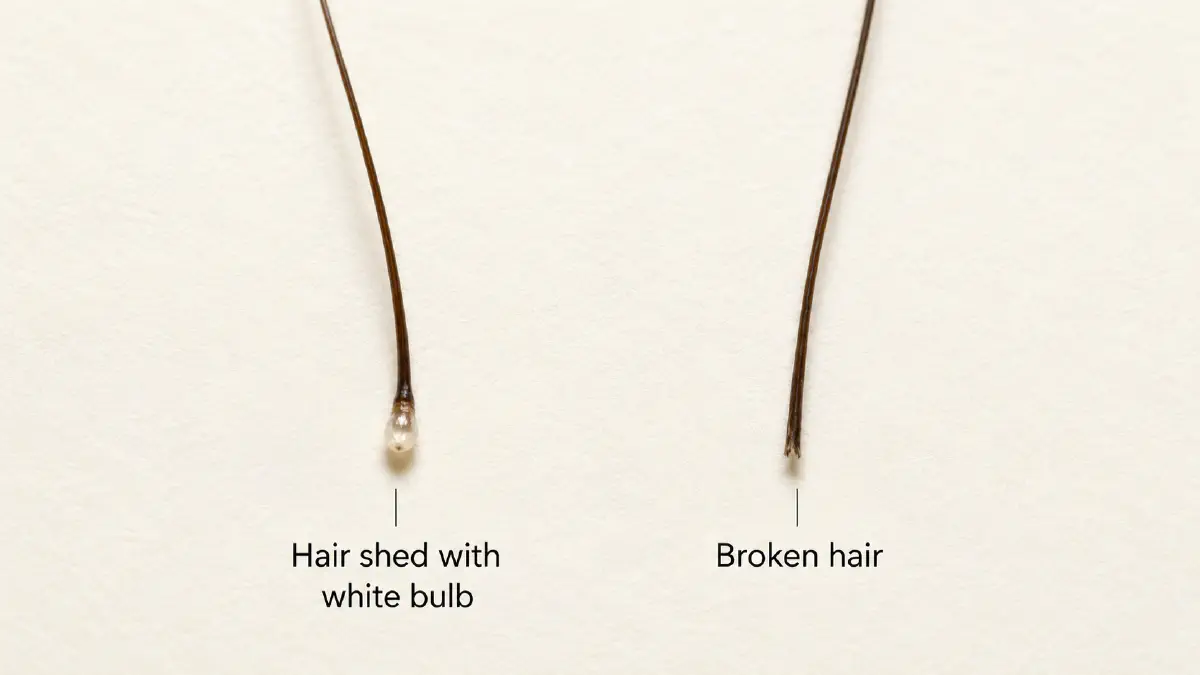
The Home Pull Test: Shed vs. Breakage
Not everything that comes out in your hand is the same kind of hair loss, and this is a genuinely useful, low-effort way to tell the difference yourself. Take a small section of hair, gently pinch it between your thumb and forefinger, and apply light tension along the strand rather than yanking:
- A small white or translucent bulb at the root means the hair had already finished its cycle and released naturally — this is normal telogen/exogen shedding, not a problem to fix.
- A blunt, frayed, or jagged end with no bulb, snapped somewhere mid-strand, means breakage — usually from friction, dryness, harsh detangling, or styling stress — which is a different issue with a different fix than shedding.
👉 One common, often-overlooked breakage cause worth ruling out here: see Hard Water and Hair Fall if your strands also feel rough or mineral-coated — hard water is a genuine breakage driver, not a shedding one, and produces exactly this no-bulb pattern.
This home version is a simplified take on the actual clinical hair pull test, where a dermatologist grasps roughly 40-60 hairs and counts how many release: under the current evidence-based guideline, 0-2 hairs coming free on a gentle pull is normal, while 6 or more (roughly 10%) points toward active shedding worth investigating further (McDonald et al., Journal of the American Academy of Dermatology, 2017). Your at-home version with a few strands won’t diagnose anything on its own, but it’s a genuinely useful way to stop lumping “shed” and “breakage” together as one scary pile of hair.
When to See a Dermatologist Instead of Troubleshooting at Home
A concentrated morning shed within the normal range doesn’t need medical attention. These signs do:
- Patchy hair loss rather than diffuse, all-over thinning — patchiness points away from ordinary shedding entirely
- A sudden, dramatic increase that doesn’t settle back down within a few weeks
- Shedding that continues for months after an obvious trigger (illness, major stress, a crash diet, childbirth) has already passed — see Postpartum Hair Loss for how that specific timeline is supposed to look
- Visible thinning at the part line or crown, not just loose strands on the pillow
- Hormonal signals alongside the shedding — irregular cycles, new acne, or unexplained weight changes — see How to Stop Hormonal Hair Fall Naturally for how PCOS and thyroid issues actually show up in hair specifically
None of the routine below is a substitute for that kind of evaluation if these signs are actually present.
The Night Routine: What Actually Helps
1. Swap a tight bun or ponytail for a loose braid or dupatta wrap
Tight overnight tension pulls repeatedly at the same follicles for hours, adding real traction stress on top of the normal shed that’s already happening. A loose three-strand plait or a soft dupatta wrap removes that added tension without giving up the convenience of having hair contained overnight.
2. Switch to a satin or silk pillowcase (or a satin cap over a cotton one)
The mechanism here is straightforward: a smoother, lower-friction surface means less tugging and tangling against hair overnight, which independent textile testing has measured as a meaningful friction reduction compared to cotton. The honest caveat is that this hasn’t been tested in the kind of rigorous clinical trial that exists for, say, scalp massage — the recommendation comes from the friction mechanism itself and consistent dermatologist endorsement, not a dedicated hair-breakage RCT. It’s a genuinely low-risk, low-cost swap either way.

3. Detangle dry, before washing — ends first, then work upward
Wet hair’s cuticle is more elastic and more fragile, so detangling from the roots downward while soaking wet tends to cause more mid-shaft snapping — breakage that then gets misread as extra shedding the next time you check your comb. Working through knots with a wide-tooth wooden comb while hair is still dry, starting at the ends and gradually working up, causes noticeably less of this.
4. Optional: a scalp-parting-only overnight treatment
A thin line of diluted fenugreek (methi) water or onion juice mixed with aloe gel, applied only along the parting with a cotton bud (not the whole scalp) and left overnight under a loose cotton cap, is a common step in this routine — worth using with realistic expectations about what the evidence actually shows:
- Fenugreek water’s practical benefit is slip, not a proven growth effect from this exact application. Soaked fenugreek seeds release a mucilage (galactomannan) that reduces friction against the pillow overnight. There is a real randomized, placebo-controlled trial showing improved hair volume and thickness after 6 months (Schulz, Bielfeldt & Reimann, Kosmetische Medizin, 2006) — but that trial tested a 300 mg oral fenugreek supplement, not a topical scalp application, so the growth claim doesn’t directly transfer to this recipe. The friction-reducing slip, on the other hand, is just basic plant chemistry and doesn’t need a trial to be true.
- Onion juice has real regrowth evidence, with an important population caveat. A controlled trial found topical onion juice significantly outperformed tap water for regrowth (Sharquie & Al-Obaidi, The Journal of Dermatology, 2002) — but the study population had alopecia areata, an autoimmune patchy hair-loss condition, not ordinary diffuse shedding. It’s reasonable evidence for onion juice in that specific context; using it here is more about the same friction-reducing logic as fenugreek than a regrowth guarantee for normal morning shed.
This step is the lowest-confidence part of the routine and entirely optional — the loose braid, satin pillowcase, and dry-detangling steps above cost nothing, carry no real downside, and have the more straightforward mechanism behind them.
5. A 2-minute gentle scalp massage before sleep
Using fingertips, not nails, in small circles along the hairline and crown for 2 minutes has real (if small-scale) clinical support for improving hair thickness over time.
👉 See Scalp Care / “Head Spa” for the full massage study and technique details.
What This Routine Realistically Does (and Doesn’t)
This routine reduces the breakage layered on top of normal shedding — less traction damage, less friction, less wet-detangling snap — which is the part that’s actually within your control. What it doesn’t do is change how many follicles are cycling into telogen on a given week, or speed up the roughly 100-day cycle itself; no product or ritual makes a follicle skip phases. If the underlying shed rate itself is elevated — from stress, a nutrient gap, or a hormonal shift — this routine makes mornings look calmer without addressing that cause directly.
👉 See Eat Your Hair Care for the nutrient side of elevated shedding, if diet is a suspected factor.
Who This Is For
This is for anyone whose morning hair-on-the-pillow moment is within the normal range but still feels alarming day to day — the routine makes the visible experience less stressful and trims the avoidable breakage stacked on top of it. It is not a fix for patchy loss, a diagnosed hormonal condition, or shedding that’s genuinely accelerating — those need the evaluation described above, not a night routine.
Tracking It Without the Daily Panic
Counting strands off the pillow every single morning is a recipe for anxiety, because the daily number swings naturally with wash days (more visible shed on the day you finally detangle a few days’ buildup) and with how much you handled your hair that day. A more honest way to track it: collect shed hair in a small pouch or box for a full week, then count once, weekly. A stable or gradually declining weekly count is the meaningful signal — a single dramatic-looking morning usually isn’t.
Frequently Asked Questions
Is it normal to lose more hair on some mornings than others?
Yes — the amount released on first touch varies with how much friction happened overnight (loose vs. tight hairstyle, how much you moved in your sleep) and how many days it’s been since you last washed or thoroughly detangled, not with how much hair you’re actually losing overall.
Does a tight braid or ponytail actually cause hair loss, or just breakage?
Mostly breakage and traction stress on the hair shaft and follicle attachment, not an increase in the underlying telogen/exogen shedding rate. Chronic, repeated tight styling over years can contribute to traction alopecia at the hairline specifically, which is a separate, more serious concern than an occasional tight bun.
Do I need real silk, or does satin work?
Either reduces friction meaningfully compared to cotton; genuine silk performs slightly better in textile friction testing, but a polyester satin pillowcase is a reasonable, more affordable version of the same mechanism.
Can the onion juice or fenugreek scalp treatment regrow hair, or just reduce friction?
Based on the actual studies behind each ingredient, treat the friction/slip benefit as the reliable part of the claim for this specific overnight-parting use. The regrowth evidence for both exists in the literature, but was tested in different contexts (an oral fenugreek supplement, and onion juice specifically for alopecia areata) than this DIY topical application.
How long before this routine actually changes what I see in the morning?
The breakage-reduction steps (loose braid, satin pillowcase, dry detangling) tend to show a difference within 1-2 weeks, since they’re preventing damage in real time. Anything tied to the underlying shed rate itself follows the hair cycle’s own multi-month timeline and won’t move faster than that, regardless of the routine.
Final Thoughts
Morning hair shed feels alarming mostly because it’s concentrated — the same daily quota of already-due-to-release hairs, delivered all at once the moment you first touch your hair, rather than spread out through the day. The pull test gives you a real way to separate that normal release from actual breakage, and the night routine trims the avoidable damage stacked on top of it without pretending to change your hair’s underlying cycle. If the shed itself looks patchy, sudden, or genuinely worsening rather than just visually concentrated in the morning, that’s the signal to loop in a dermatologist rather than adjust the pillowcase.