


“My hair fall is genetic” is a common assumption long before anyone checks what’s actually coming out of the tap. Hard water is a genuinely underrated culprit — but it’s worth being precise about what it does and doesn’t do, because the honest mechanism is different from how it usually gets described online. Here’s what the actual research shows, a simple way to test your own water, and the rinse routine that has real evidence behind it (and the parts that don’t).

What “Hard Water” Actually Means, and How to Check Yours
Hard water simply means water carrying a higher concentration of dissolved calcium and magnesium, typically picked up as groundwater passes through limestone or chalk deposits — extremely common across much of North India, where TDS readings of 300-500 ppm are routine in tap water.
A TDS meter or strip (the kind most households already own from an RO purifier) is the easiest at-home check, and a reading climbing well past the WHO’s “excellent” drinking-water threshold of 300 mg/L is a reasonable signal to investigate further (WHO Total Dissolved Solids guidance). The honest caveat: TDS and hardness aren’t quite the same measurement. TDS totals everything dissolved in the water — including sodium and chloride, which have nothing to do with hardness — while true hardness specifically measures calcium and magnesium as CaCO₃, with anything above 120 mg/L generally classified as hard, and above 180 mg/L as very hard (WHO Hardness in Drinking-water). A TDS strip is a convenient, accessible starting point, not a lab-accurate hardness test — but for a household trying to figure out “is this even worth investigating,” it’s a reasonable enough proxy.
What Hard Water Actually Does to Hair
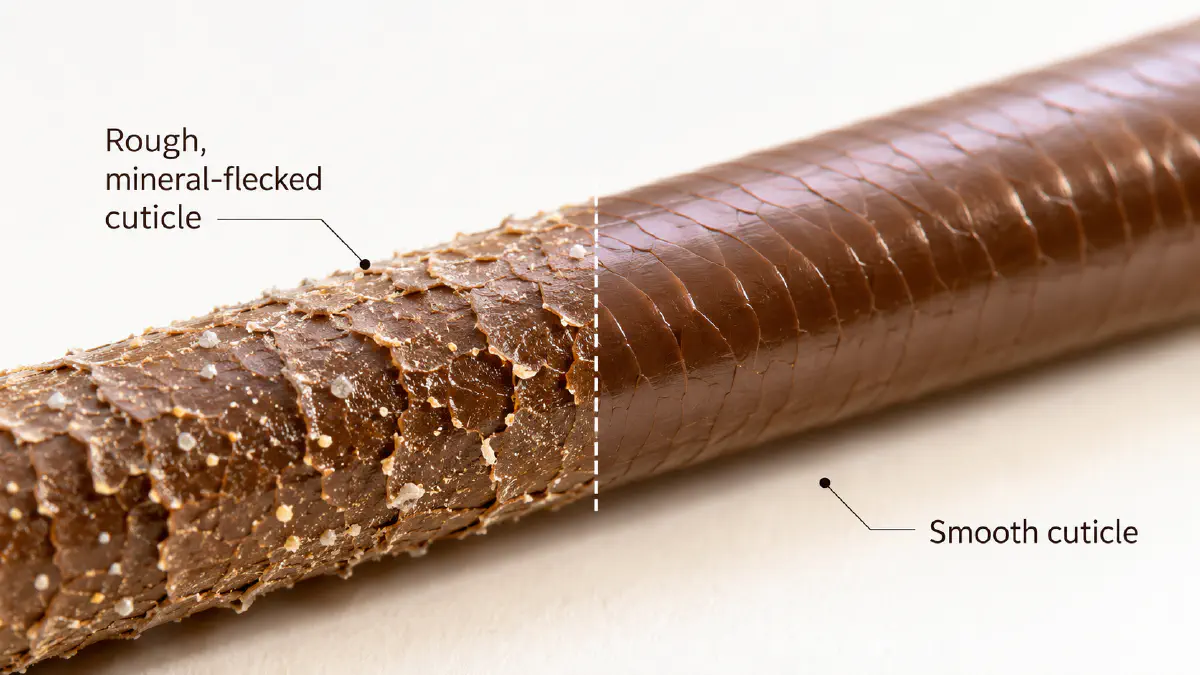
Calcium and magnesium ions in hard water don’t stay in the water — they deposit onto the hair shaft, clustering around and just beneath the edges of the cuticle scales, where they interfere with the hair’s ability to absorb and hold onto moisture (Effects of Hard Water on Hair, PMC3927171). A scanning electron microscopy study on hair washed in hard water confirmed measurably higher magnesium deposition compared to hair washed in soft water — though, in an honest and less dramatic finding than most hard-water content reports, that same deposition wasn’t always associated with a statistically significant increase in visible shaft damage under the microscope (Alahmmed et al., Indian Journal of Dermatology, Venereology and Leprology, 2017).
Where the evidence is more consistent is mechanical strength: a controlled trial measuring the actual breaking force of hair treated with hard water versus deionized water found hard-water-treated hair broke under measurably lower tension (International Journal of Trichology, 2018) — the same trusted journal behind the pH research cited in our DIY Shampoo guide. Roughened, mineral-coated cuticle plus reduced moisture retention adds up to hair that’s measurably more prone to snapping under normal combing and styling tension.
The Critical Distinction: This Is (Mostly) a Breakage Story, Not a Shedding Story
This is the honest correction worth making before anything else: hard water does not attack hair follicles the way genetics, hormones, or telogen effluvium do — there’s no strong evidence it pushes more follicles into the shedding phase. What it reliably does is weaken the existing hair shaft, so more of it snaps off mid-strand under normal handling. A double handful of hair on the bathroom floor can look and feel identical whether it’s genuine follicular shedding or accumulated shaft breakage — but the fix for each is completely different.
👉 Use the pull test from our Morning Hair Shed guide to tell them apart: a small white bulb at the root means normal shedding (not a water problem); a frayed, blunt end with no bulb means breakage — exactly the pattern hard water produces.
The one real exception: on scalps already dealing with eczema, psoriasis, or significant irritation, hard water’s mineral and pH stress can aggravate the scalp itself enough to affect the follicles there specifically — which is a dermatologist question, not a rinse-routine one. If the shedding looks diffuse and patchy rather than tied to visibly rough, dull, mineral-coated strands, see our hormonal hair fall guide for the causes actually worth investigating first.
Hot Water Makes It Worse
Heat opens the hair cuticle further, which increases how much mineral content gets absorbed into the shaft during a hot-water wash rather than rinsing away. Washing with lukewarm rather than hot water doesn’t eliminate hard water’s effect, but it measurably reduces how much mineral uptake happens per wash — a free adjustment with no downside.
The Rinse Routine: What’s Actually Worth Doing
1. A diluted apple cider vinegar rinse — real benefit, with a real limit
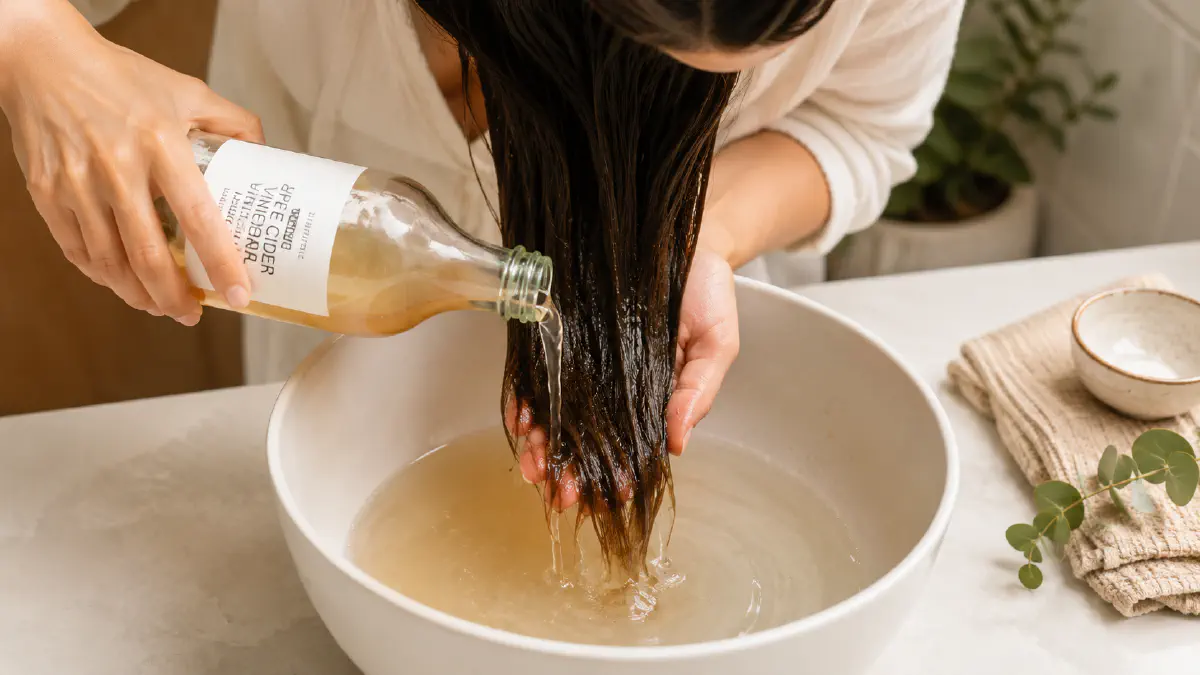
Mixing roughly 2 tablespoons of raw apple cider vinegar into 1 litre of filtered water and using it as a final rinse works through a genuine, well-understood mechanism: hair’s natural pH is acidic, and ACV’s low pH (diluted to a safe strength) helps flatten the lifted cuticle scales that alkaline mineral deposits leave behind, restoring some smoothness and shine. The honest limitation: ACV is not a true chelator. Ingredients like EDTA or citric acid — the active agents in an actual chelating shampoo — chemically bind and lift calcium and magnesium that are bonded to the hair protein itself; ACV’s acidity loosens some surface deposit and improves how the cuticle lies, but doesn’t remove mineral buildup the way a dedicated chelating product does.
👉 See our Clarifying Shampoo guide for when a genuine chelating shampoo — not just an ACV rinse — is the more targeted fix for a hard-water area specifically.
Never apply ACV undiluted — at full strength it’s acidic enough to irritate skin and scalp; always dilute at roughly this 1:8 ratio or weaker, and keep it off broken skin.
2. A pre-wash barrier: aloe vera gel and glycerin
Applying a thin layer of aloe vera gel with a few drops of glycerin to the scalp about 30 minutes before washing is a reasonable, low-risk mechanical logic: both are humectants that coat the hair surface, plausibly giving mineral ions less direct cuticle contact during the wash itself. This specific combination hasn’t been tested in a dedicated trial, so treat it as a sensible precaution rather than a proven barrier — it costs little and doesn’t conflict with anything else in this routine.
3. A rice water and multani mitti pre-wash detox
Massaging a mix of fermented rice water and multani mitti (Fuller’s earth) into the scalp for 10 minutes before shampooing uses multani mitti’s natural clay adsorption to help lift surface buildup mechanically, while rice water’s starch content is already established on this site as a mild film-forming agent.
👉 See Rice Water 2.0 for Hair Growth: The Fermented Peptide Method for the full fermentation process and what it’s separately evidenced for.
4. An inline shower filter (KDF/carbon)
A budget shower-head filter using KDF or activated carbon media does measurably reduce some dissolved mineral content and chlorine before water reaches your hair — a real, ongoing reduction rather than a per-wash fix. The realistic expectation: these filters reduce mineral load, they don’t fully soften water the way a whole-house softener does, so combining one with an occasional chelating rinse is more realistic than expecting the filter alone to solve significant hardness.
5. Wash-day habits that reduce cumulative deposit
- Avoid daily hot showers — lukewarm water specifically for the hair-washing portion, per the mechanism above
- A chelating (or ACV) rinse once weekly rather than daily — overusing an acidic rinse can itself strip hair, so weekly is a reasonable starting cadence, adjusted for how visibly rough hair feels
- Clean the showerhead monthly with a vinegar soak — mineral scale accumulates inside the fixture itself and keeps redepositing onto hair regardless of any rinse routine
Who This Is For (and What It Doesn’t Fix)
This routine is genuinely useful for anyone whose hair feels rough, dull, or straw-like and sheds visibly more from breakage in a known hard-water area. It is not a treatment for diffuse, root-level shedding tied to hormones, stress, or nutrient deficiency — those need the causes covered in our hormonal hair fall guide and Eat Your Hair Care, not a chelating rinse. The pull test above is the fastest way to know which category applies before spending weeks on a routine aimed at the wrong problem.
Frequently Asked Questions
Is a TDS meter accurate enough to diagnose hard water?
It’s a reasonable, accessible starting signal — a high reading is worth investigating further — but it measures total dissolved solids broadly, not calcium and magnesium specifically, so treat it as a proxy rather than a precise hardness test.
Can hard water alone cause visible thinning at the crown or hairline?
Not through the shedding mechanism itself — that pattern is more consistent with hormonal or genetic causes. Hard water’s damage shows up as diffuse breakage and rough texture across the lengths, not a specific thinning pattern at the part or hairline.
How long before a chelating or ACV rinse routine shows a difference?
Surface smoothness and reduced breakage from existing buildup often improve within 2-3 washes, since the rinse is addressing deposit already on the hair. If shedding itself doesn’t improve after a few weeks of consistent use, that’s a signal the actual cause may not be water hardness.
Is bottled or filtered water necessary for every wash?
Not necessary for daily washing in most cases — the routine above (rinse, pre-wash barrier, lukewarm water) is designed to work with regular tap water. Filtered or bottled water for the final rinse specifically is most useful while traveling, or in areas with unusually high hardness or a noticeable sulfur/chalk smell.
Final Thoughts
Hard water is a genuinely underrated cause of rough, breakage-prone hair — but the honest mechanism is mineral deposit weakening the hair shaft, not follicles shutting down. A TDS check, a diluted weekly chelating rinse, lukewarm washes, and the pull test to confirm what’s actually happening are enough to address it realistically. If the shedding turns out to be diffuse root-level loss rather than shaft breakage, that’s the cue to look at hormones and nutrition instead of reaching for another rinse.