

Terms like “anagen,” “telogen effluvium,” and “shortened growth phase” show up constantly across hair-growth content — including several of our own guides — usually without ever explaining what they actually mean. Understanding the underlying cycle clarifies almost every other hair-growth claim you’ll encounter: why DHT causes gradual thinning rather than sudden baldness, why stress causes sudden shedding rather than gradual thinning, and why literally every treatment on this site takes months, not days, to show results.
The 4 Phases
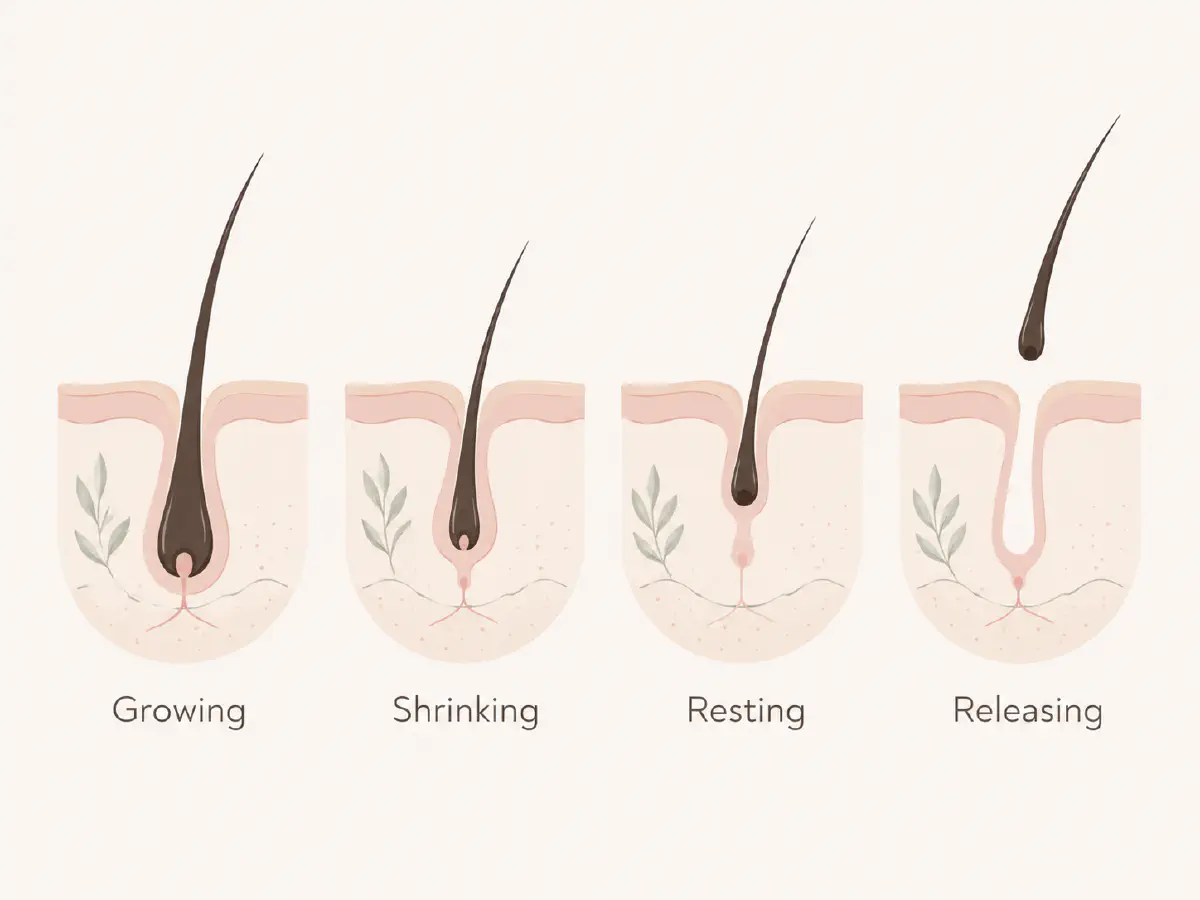
| Phase | What Happens | Typical Duration | % of Follicles at Any Time |
|---|---|---|---|
| Anagen (growth) | Active cell division; the hair is actively lengthening | 2-8 years | ~85-90% |
| Catagen (transition) | Growth stops; the follicle shrinks and detaches from its blood supply | ~2 weeks (~10 days) | 1-3% |
| Telogen (resting) | The follicle sits dormant; the hair is fully formed but not growing | ~2-3 months (~100 days) | ~9-10% |
| Exogen (shedding) | The old hair actually releases and falls out, often as a new hair is already forming beneath it | Overlaps with late telogen | Varies |
Source: Integrative and Mechanistic Approach to the Hair Growth Cycle and Hair Loss, PMC.
One Follicle’s Journey, Start to Finish
It helps to follow a single follicle through the whole cycle rather than just memorizing the table above. Day one of anagen begins with active cell division at the follicle’s base, and the hair lengthens steadily for anywhere from 2 to 8 years, depending on your individual genetics. Eventually, a signal triggers catagen: growth stops, the follicle detaches from its blood supply, and it shrinks to roughly a sixth of its original length over about 2 weeks. The follicle then enters telogen, sitting dormant for around 100 days while the fully-formed (but no-longer-growing) hair simply stays put. Toward the end of telogen, exogen begins — the old hair actually releases, often nudged out by a new hair already forming underneath it — and the whole cycle restarts with a new anagen phase.
Why This Matters: Each Follicle Cycles Independently
Your scalp follicles aren’t synchronized — each one is on its own timeline, moving through these phases independently of its neighbors. This is exactly why healthy hair loss looks like gradual, low-level daily shedding (50-100 hairs is considered normal) rather than losing hair in one dramatic event. It’s also why any single hair you find has already been growing anywhere from a few months to several years, depending on where in the cycle its neighbors happen to be.
Why Some People Can Grow Much Longer Hair Than Others
This is a genuinely useful, often-overlooked implication of the cycle: your maximum possible hair length is largely determined by how long your individual anagen phase runs, not by anything you do to your hair day-to-day. Someone with a naturally longer anagen phase (say, 6-7 years) can grow hair to waist length before it ever reaches telogen and eventually sheds; someone with a shorter anagen phase (2-3 years) may find their hair reliably stops getting noticeably longer past shoulder length, no matter how well it’s cared for. This is genetic, not a reflection of hair health or how well an oil or treatment is “working.”
How Doctors Actually Measure This
The trichogram is the standard clinical method for assessing what proportion of follicles are in each phase at a given time — a small number of hairs are pulled and examined microscopically to classify each by its root shape, which differs distinctly between anagen and telogen hairs. This is the same method behind the seasonal shedding research cited in our seasonal changes guide, and it’s what a dermatologist may use if shedding seems abnormal enough to investigate further.
How This Explains Common Hair Concepts
DHT and Pattern Hair Loss: A Shrinking Anagen Phase
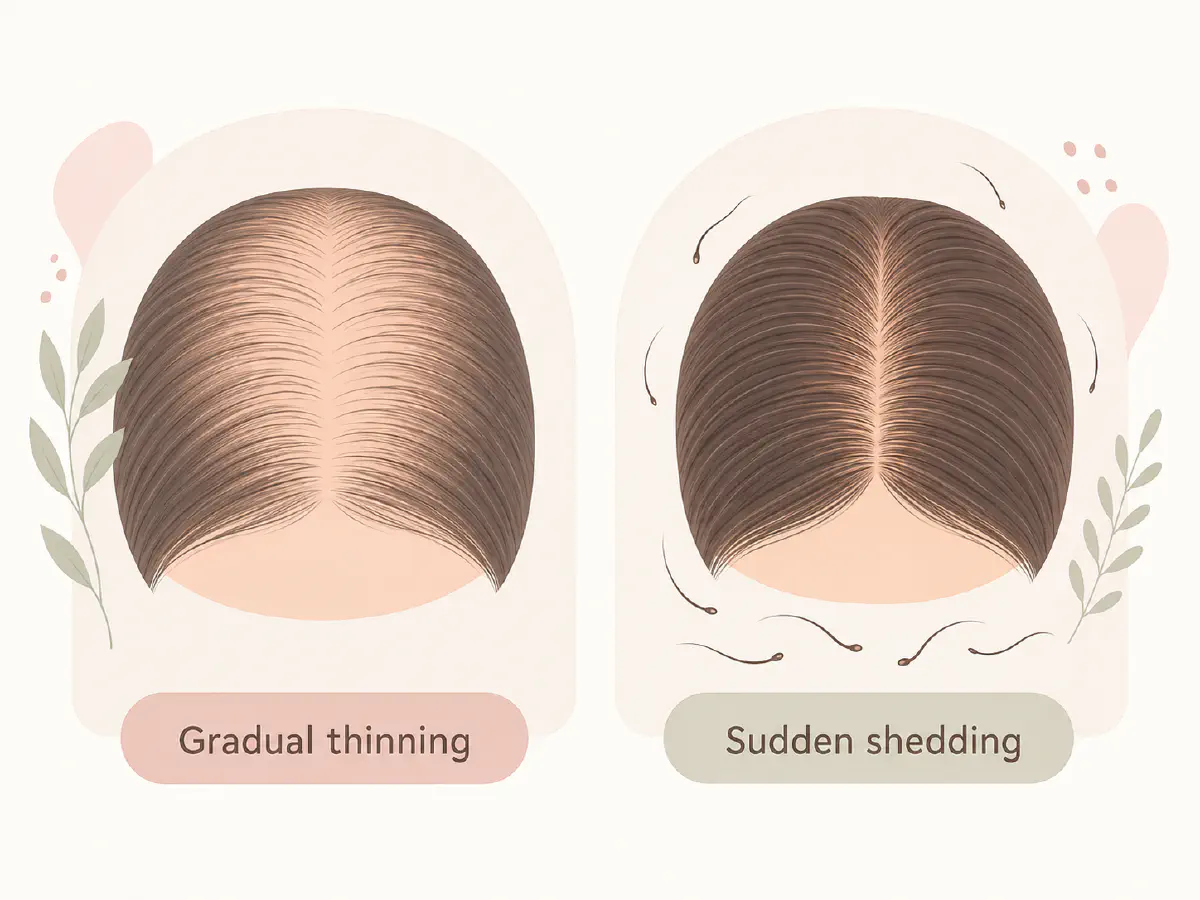
DHT-sensitive follicles don’t stop growing hair suddenly — they go through progressively shorter anagen phases with each cycle, producing finer, shorter hairs over successive cycles until visible thinning appears. This is why pattern hair loss looks gradual rather than sudden.
👉 See our natural DHT blockers guide for the full mechanism and what evidence exists for managing it.
Telogen Effluvium: A Stress Signal Pushes Too Many Follicles Into Rest at Once
Rather than DHT’s gradual anagen-shortening, a physical or emotional shock (illness, major stress, hormonal shift, crash diets) can trigger a disproportionate number of follicles to shift into telogen simultaneously. Because telogen lasts around 100 days, the resulting shed often shows up roughly 3 months after the actual triggering event — which is why the cause and the visible shedding rarely line up in people’s minds.
👉 See our hormonal hair fall guide for how this plays out with PCOS, thyroid issues, and stress specifically.
Seasonal Shedding: A Real, Measurable Telogen Shift
The percentage of follicles in telogen genuinely fluctuates by season, peaking in mid-to-late summer and translating to more visible shedding roughly 100 days later, in autumn.
👉 See our full seasonal changes guide for the actual trichogram study data behind this pattern.
Why Every Hair Treatment Takes Months, Not Days
This is the single most important practical takeaway from understanding the cycle: no product can make a follicle skip phases. Extending anagen, shortening telogen, or reactivating a dormant follicle all require completing a meaningful portion of a multi-month cycle before the result is visible on the surface. This is exactly why the real clinical trials referenced elsewhere on this site — 12 weeks for a probiotic acne trial, 24 weeks for the Sandalore trial — all land in the same multi-month range. That’s not a marketing convention; it’s the biology of the cycle itself.
What Actually Influences the Cycle
| Factor | Phase Affected | Effect |
|---|---|---|
| DHT (genetic sensitivity) | Anagen | Progressively shortens over successive cycles |
| Acute stress/illness/hormonal shock | Telogen | Pushes more follicles into telogen simultaneously |
| Season | Telogen | Natural peak in mid-to-late summer |
| Nutrient deficiency (iron, protein) | Anagen/Telogen | Can shorten anagen or trigger early telogen shift |
👉 See Eat Your Hair Care for which specific nutrient deficiencies actually have evidence behind them, and which ones are more overstated than proven.
Frequently Asked Questions
How many hairs am I supposed to lose per day?
50-100 hairs daily is generally considered normal, reflecting the ordinary, staggered cycling of exogen-phase follicles rather than a problem. If most of that shed seems to show up right when you wake up, see Morning Hair Shed: Why It Looks Worse Than It Is for why mornings specifically concentrate it, plus an at-home way to tell normal shedding from breakage.
If I start a hair growth treatment, how long before I see results?
Because most treatments work by influencing anagen length or telogen duration rather than accelerating growth directly, meaningful visible results typically take 8-24 weeks, matching the timelines of the actual clinical trials referenced across our hair-growth guides.
Can a follicle stay in telogen permanently?
Not typically in healthy hair — the cycle normally continues, though certain conditions (severe, prolonged deficiency, some autoimmune conditions, advanced pattern hair loss) can extend telogen or halt the cycle in ways that require medical evaluation rather than home treatment.
Is exogen a separate phase, or part of telogen?
Different sources describe it differently — some treat it as the final stage of telogen, others as a distinct fourth phase — but functionally it refers to the same thing: the point where the old hair actually detaches and sheds.
Can weight-loss medications trigger this same telogen shift?
Yes — a 2026 study found GLP-1 drugs like Ozempic and Mounjaro carry a real, measurable telogen effluvium risk, tied to rapid weight loss and reduced caloric intake. See GLP-1 Hair Loss: What the New Research Actually Shows for the full data.
Final Thoughts
Nearly every hair-growth claim — DHT’s gradual thinning, sudden stress-related shedding, seasonal shed patterns, and the multi-month wait for any treatment to show results — traces back to this same 4-phase cycle. Once you understand it, “why does this take so long” stops being a frustrating mystery and becomes a predictable, biology-based timeline.